Booking choice: The Heart of the City walk, from $22 per person. Check dates Tour details
Vincenzo Bellini was born in Catania in 1801 and died near Paris in 1835, aged 33. In barely ten years of work he wrote some of the most loved melodies in Italian opera, "Casta diva" from Norma among them. Catania never let him go. His remains came home in 1876, and the city's opera house, the Teatro Massimo Bellini, opened in 1890 with Norma.
Most of the places linked to him sit within a short walk of each other in the baroque old town: the birthplace on Piazza San Francesco d'Assisi, Via Crociferi, the Duomo, Piazza Vincenzo Bellini, Piazza Stesicoro and Villa Bellini. Below are the facts behind each one, and a simple order to see them in.
The quick answer
Bellini was born in Catania on 3 November 1801 and died in Puteaux, near Paris, on 23 September 1835. His tomb is in Catania Cathedral, in the south aisle, where his remains were reburied in 1876. His birthplace is now the Museo Civico Belliniano on Piazza San Francesco d'Assisi 3, and Villa Bellini, the public garden on Via Etnea, carries his name.
Who was Vincenzo Bellini?
An opera composer from Catania, one of the central names of the bel canto era. English Wikipedia sums up his style as long, graceful melodies.
He came from a family of musicians. His grandfather, Vincenzo Tobia Bellini, had studied at the conservatory in Naples and worked in Catania from 1767 as an organist and teacher, and his father Rosario did the same. Vincenzo was the eldest of seven children. A handwritten family history kept in the Museo Civico Belliniano claims he sang an aria at eighteen months and composed his first pieces at six. His biographers treat some of that as legend, but the talent was real enough for the city to pay for his studies.
Other composers took him seriously. Verdi praised his long melodies as unequaled, Wagner admired how he joined music and words, and Liszt and Chopin were admirers too (English Wikipedia). His operas still play on the big stages of the world, Norma and La sonnambula first.
Catania also eats him. Pasta alla Norma, with fried aubergine, tomato sauce and salted ricotta, is named after his opera, and you will find it on menus all over the old town.
Which operas did Bellini write?
Ten, from Adelson e Salvini in Naples in 1825 to I puritani in Paris in 1835. Norma and La sonnambula are the most famous.
The Museo Civico Belliniano shows stage models for all ten of his operas in its entrance hall. Here are the main ones, with the houses where they first played, as English Wikipedia lists them:
| Opera | Year | First performed |
|---|---|---|
| Adelson e Salvini | 1825 | Naples conservatory |
| Bianca e Fernando | 1826 | Naples, a commission linked to the Teatro di San Carlo |
| Il pirata | 1827 | La Scala, Milan |
| I Capuleti e i Montecchi | 1830 | La Fenice, Venice |
| La sonnambula | 1831 | Teatro Carcano, Milan |
| Norma | 1831 | La Scala, Milan |
| Beatrice di Tenda | 1833 | Venice |
| I puritani | 1835 | Théâtre-Italien, Paris |
La straniera (Milan) and Zaira (Parma) complete the ten. Il pirata made his name. Norma, written for the soprano Giuditta Pasta, holds "Casta diva", the prayer to the moon that most people know even without knowing where it comes from.
Catania plays its son often. I Puritani opened the autumn at the Teatro Metropolitan from 24 September to 1 October 2026, with Jessica Pratt. And La sonnambula is in the 2027 season of the reopened house, from 23 September to 1 October 2027, opening on the anniversary of his death. The reopening post has the whole 2027 program.
Where did Bellini live and work?
In Catania until 1819, then eight years in Naples, then Milan and Venice, a summer in London in 1833 and Paris until his death.
In May 1819 the city fathers of Catania voted him a four-year grant to study at the Real Collegio di Musica di San Sebastiano in Naples, and he left home that July. His teacher there, the composer Niccolò Zingarelli, gave him advice he clearly took: make your music sing. In Naples he also met Francesco Florimo, his lifelong friend and first biographer.
Milan came next, with Il pirata at La Scala in 1827, and with it a run of successes in the north. After London he settled in Paris, and later in Puteaux, half an hour by road from the center, where he worked on I puritani as the guest of an English friend.
He came home only once as a famous man. On 3 March 1832 Catania gave him a civic welcome, and the next evening a concert of music from La sonnambula and Il pirata at the Teatro Comunale. That provisional theatre was later replaced by the Teatro Massimo Bellini, built in his honor. The museum has a panel for each stage of his life: Catania, Naples, Milan, Palermo, London and Paris.
The cathedral with Bellini's tomb, Via Crociferi and the fish market, on a two-hour walk with a licensed guide.
Check dates for the Heart of the City walkHow did Bellini die?
Of an illness of the intestine, in Puteaux near Paris, on 23 September 1835. He was 33.
English Wikipedia describes a gastric illness that came back after almost every opera he wrote. In September 1835 it returned at Puteaux. A doctor sent notes to the Théâtre-Italien over several days, first hopeful, then not. Bellini died on the afternoon of 23 September, in the thirteenth day of the illness.
Rossini took charge. He ordered a post-mortem, and the court doctor who performed it reported an acute inflammation of the colon with an abscess in the liver. Rossini also organized a funeral mass at the Invalides in Paris, and Bellini was buried in Père Lachaise cemetery, a resting place Rossini saw as temporary. The museum in Catania keeps original papers on his death and a wax cast of his face.
Where is Bellini's tomb?
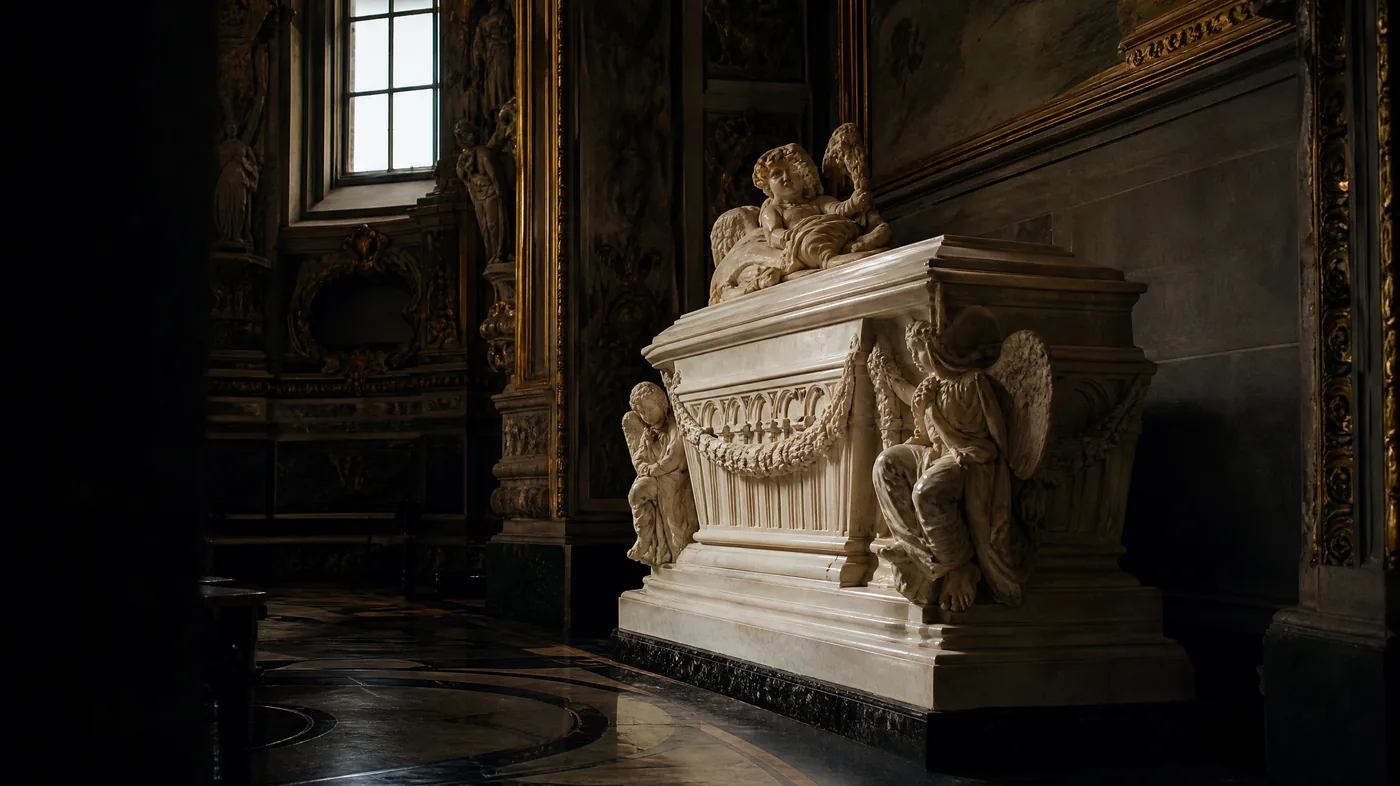
In Catania Cathedral, the Cattedrale di Sant'Agata on Piazza Duomo. It stands on a pilaster in the south aisle, and his remains have been there since 1876.
It took more than forty years and many attempts to bring him home. In 1876 the casket finally traveled from Paris to Catania and was reburied in the cathedral. The empty tomb in Père Lachaise is still there, next to Rossini's.
Walk in from Piazza Duomo and keep to the right. In the south aisle you pass the baptistery, then a canvas of Saint Febronia by Borremans at the first altar. Bellini's tomb faces it, set on a pilaster. Look for the line of music carved on it. It comes from Amina's last aria in La sonnambula: "Ah! non credea mirarti / sì presto estinto, o fiore", I did not believe you would fade so soon, oh flower. For a man who died at 33, it is hard to read without a pause.
The cathedral itself was rebuilt in baroque style after the earthquake of 1693, with a facade by Gian Battista Vaccarini, while the Norman apses of lava stone survive from the eleventh century. Italia.it adds that the closing concert of the yearly Bellini Festival is held here on 3 November, his birthday. The Heart of the City walk starts in Piazza Duomo and takes a look inside the cathedral.
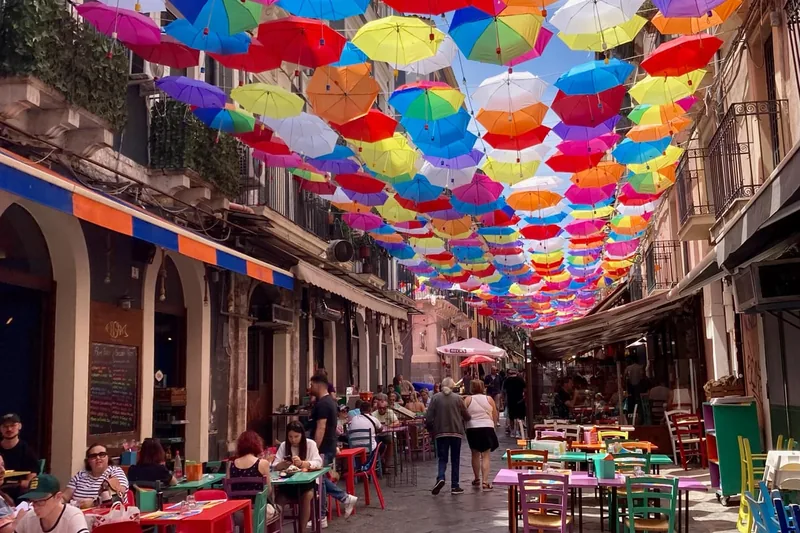
Piazza Duomo, the cathedral where Bellini rests, the fish market and Via Crociferi in two hours.
Explore the Heart of the City walk Tour detailsCan you visit the house where Bellini was born?
Yes. It is the Museo Civico Belliniano, on the first floor of Palazzo Gravina Cruyllas at Piazza San Francesco d'Assisi 3.
Bellini was born in this apartment and lived his first sixteen years here, says Italian Wikipedia. It became a national monument in 1923, and the museum opened on 5 May 1930. The rooms are small and packed, and that is the charm of it:
- Music in his own hand. Autograph scores and sketches, the core of the collection, and a score of La sonnambula.
- His instruments. A fortepiano that belonged to him, his grandfather's spinet and a table piano.
- Letters. From Rossini, from the soprano Giuditta Pasta and from his lover Giuditta Turina, who also embroidered two rugs on show.
- The last chapter. His death mask, papers on his death at Puteaux and a room on the return of his remains in 1876.
Since 23 March 2023 the same palazzo also holds a multimedia museum, "Una vita in quattro atti" (a life in four acts), which follows him from Catania to Paris. Italia.it notes that the palazzo stands over the remains of the ancient Odeon and Roman theatre, which you can see just behind it. Opening hours are on the museum's own site, Museo Vincenzo Bellini, so check them before you go.
Bellini was baptized close by, in the church of San Francesco di Paola on Via Crociferi (Italia.it). The City Highlights walk crosses Piazza San Francesco on its way through the old town.
Is Villa Bellini named after the composer, and where is his monument?
Yes. Villa Bellini is a public garden on Via Etnea, not the theatre. His monument stands in Piazza Stesicoro, a little further down Via Etnea.
Catanians simply call the garden 'a Villa. Its oldest part was the eighteenth-century garden of the prince of Biscari, laid out as a maze and known as the Labirinto. The city bought it in 1854, a bust of Bellini went up on the Via Etnea side in 1866, and the public garden opened on 6 January 1883. Look out for the Chiostro della Musica, a bandstand from 1879, and the avenue of busts of famous Italians and Catanians. The grand entrance on Via Etnea dates from 1932.
Opera has played here too. In July 1935 the garden staged summer performances of Norma, La sonnambula and Il pirata with Tito Schipa (Italian Wikipedia). The Teatro Metropolitan, where the theatre's season runs during the works, stands on Via Sant'Euplio right next to the garden.
The monument in Piazza Stesicoro is by Giulio Monteverde and was unveiled on 21 September 1882. Around his statue stand four figures for four of his operas: Norma, I puritani, La sonnambula and Il pirata. Beside it lie the lava-stone ruins of the Roman amphitheatre. The Catania by Night walk ends right here after dark, a fine place to finish an evening.
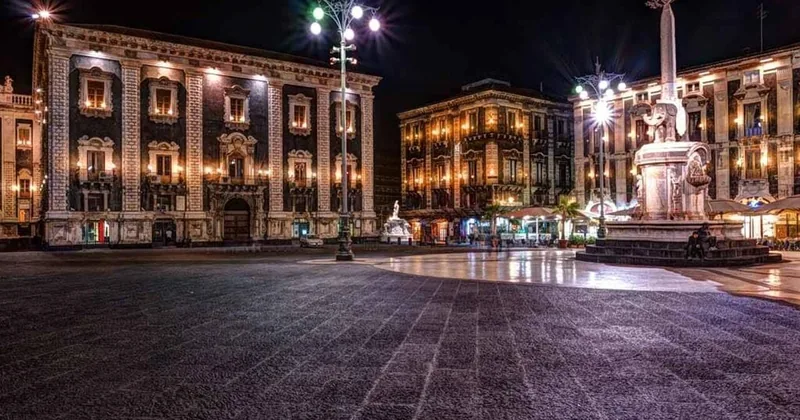
Via Crociferi, Piazza Duomo and Via Etnea after dark, ending at the Bellini monument and the Roman amphitheatre.
Explore the evening walk Tour detailsHow do you follow Bellini's trail through Catania?
On foot, in one easy day. Start at the birthplace, walk Via Crociferi to the Duomo, then go on to Piazza Vincenzo Bellini, Piazza Stesicoro and Villa Bellini.
Italia.it suggests this same order for a Bellini route through the baroque city. Here it is with what to look for at each stop:
| Stop | Where | What to see |
|---|---|---|
| Museo Civico Belliniano | Piazza San Francesco d'Assisi 3 | His birthplace, scores, instruments |
| Via Crociferi | From the Arch of San Benedetto | Baroque churches; San Francesco di Paola, where he was baptized |
| Catania Cathedral | Piazza Duomo | His tomb in the south aisle |
| Teatro Massimo Bellini | Piazza Vincenzo Bellini | The opera house named after him |
| Bellini monument | Piazza Stesicoro | Monteverde's statue and four opera heroines |
| Villa Bellini | Via Etnea | The garden, his bust, the bandstand |
The theatre is closed for safety works until 31 December 2026, and guided tours are suspended, so this year you see it from the square. The house reopens in March 2027 with Nabucco, from 6 to 14 March 2027. Its history, from the 1812 project to the painted ceiling, is in our history guide.
For the music itself, the Christmas classical concert in the Badia di Sant'Agata plays Bellini and Vivaldi with a string quartet, a few steps from his tomb. And if you want a guide for the old town part of the trail, pick the Heart of the City walk by day or the evening walk after dark.
A string quartet, music by Bellini and Vivaldi, a baroque church by the Duomo: the Christmas concert.
Check dates for the Christmas concertFrequently asked questions
Where is Vincenzo Bellini buried?
In Catania Cathedral on Piazza Duomo, on a pilaster in the south aisle. His remains were brought from Paris in 1876.
How did Bellini die?
Of an acute inflammation of the colon with an abscess in the liver, according to the post-mortem reported on English Wikipedia. He died in Puteaux, near Paris, on 23 September 1835, aged 33.
Why is the theatre in Catania called Bellini?
It is named in honor of the composer, who was born in Catania. The Teatro Massimo Bellini opened on 31 May 1890 with his opera Norma.
Is Villa Bellini the same as the Teatro Bellini?
No. Villa Bellini is a public garden on Via Etnea. The opera house is the Teatro Massimo Bellini on Piazza Vincenzo Bellini.
Ready to book
Choose your tour
Free cancellation up to 24 hours before on every option. Prices are from-prices in USD and move with the season.
Catania by Night: Baroque and History Walk
- An official licensed tour leader
- Two hours through the lit old town
- Piazza Teatro Massimo and the Bellini monument
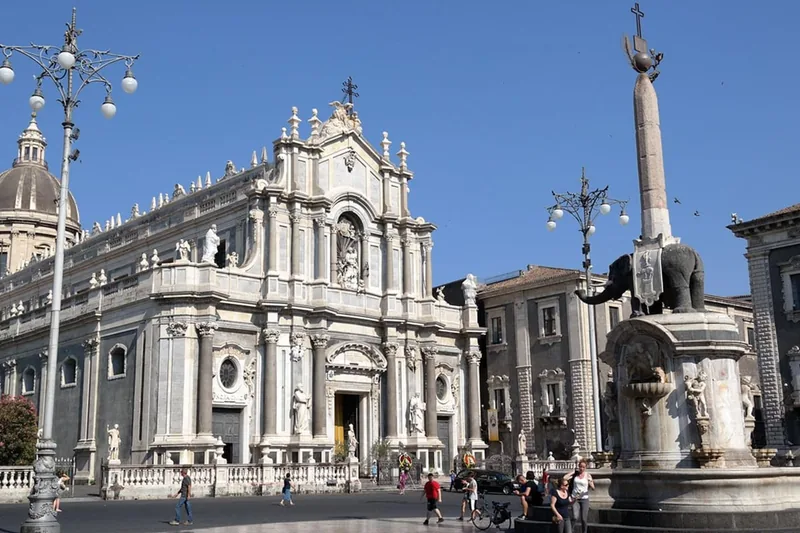
Catania City Highlights Walking Tour
- A local guide for two hours
- Piazza Duomo, the Pescheria and Ursino Castle
- Piazza Università and Piazza Vincenzo Bellini